
Thomas County Arrest Records and Charges
Thomas County arrest records may appear first through the Sheriff's Office inmate roster, jail booking record, warrant paperwork, or arresting agency file. Those records can show the person booked, booking number, age, booking date, listed charges, and bond amount when posted. They do not always show the final court charge, the final count, or the final case outcome. The Sheriff's inmate profile warning says charges and bail amounts may change after court appearances and that people posting bail should contact jail staff for correct bail, charges, and case numbers.
Court charges after arrest are the formal charges that move through Magistrate Court, State Court, or Superior Court. Law enforcement may arrest and book a person, but the District Attorney or Solicitor General decides how charges are prosecuted. Felonies move through Superior Court in the Southern Judicial Circuit. Misdemeanors and traffic offenses often move through State Court. The full outcome appears in the Thomas County criminal court records case file, not in a booking card alone.
Where Thomas County Charges First Appear
Charges can appear in more than one place because each office records a different part of the same event. A jail charge may reflect the booking or warrant basis. A Magistrate warrant or preliminary hearing may reflect probable cause and early court review. A State Court accusation, Superior Court accusation, or Superior Court indictment is a filed court charge. Charge status can then change through amendment, reduction, dismissal, nolle prosequi, plea, trial, or sentencing.
| Charging Document | Where It Fits | Thomas County Use |
|---|---|---|
| Complaint or warrant-based filing | Early allegation or warrant support. | Often tied to Magistrate warrant, preliminary, or arrest paperwork. |
| Accusation | Prosecutor-filed charging document. | Common for misdemeanors and some criminal filings in State or Superior Court. |
| Indictment | Formal grand-jury felony charge. | Used in Superior Court felony prosecution when applicable. |
Find Thomas County Arrest Records
The Sheriff's Office inmate roster is the main local public source for current or released county jail custody. It can be searched by name, filtered by current or released status, sorted by booking date, and opened to view profile detail. The sample Thomas County inmate profile source is assigned to this arrest-record path.
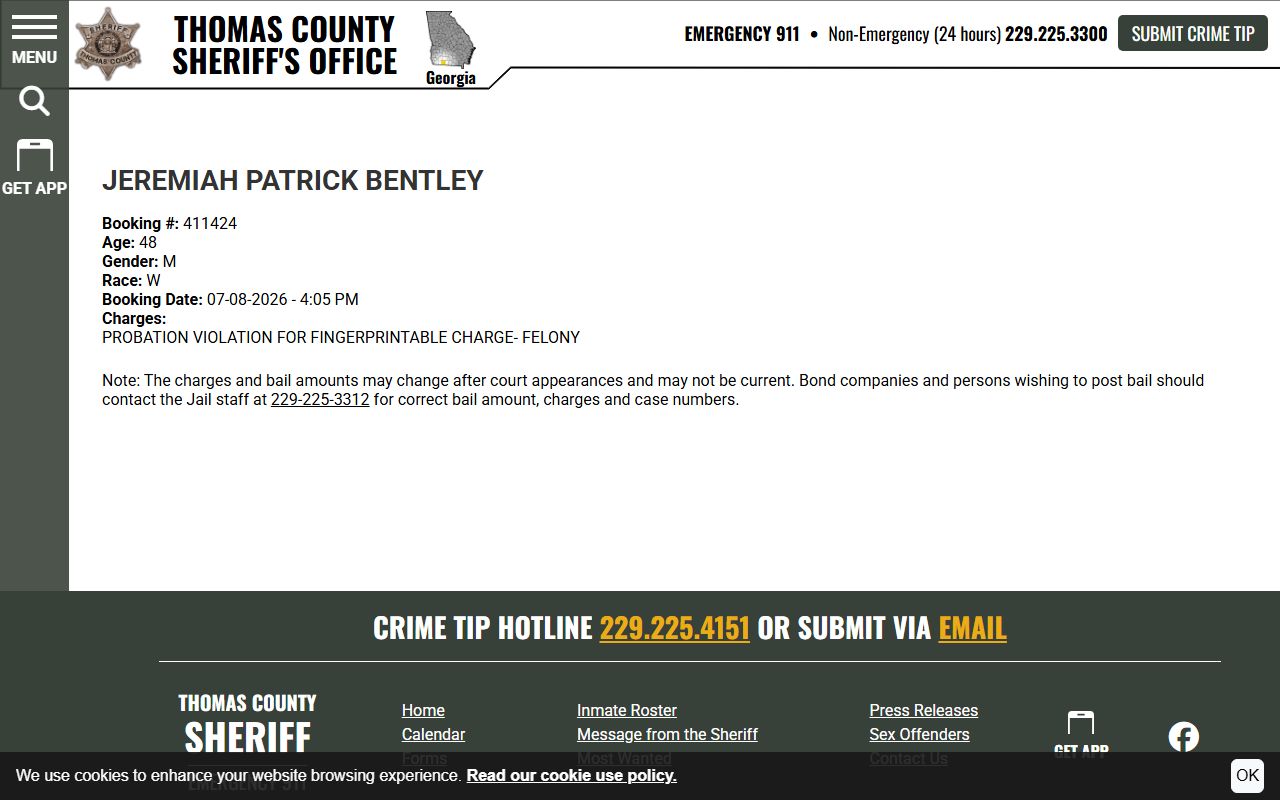
The sample supports the key caution for Thomas County arrest records: booking charges are a starting point, and jail staff should be contacted for current bail, charges, and case numbers.
- Search the Sheriff's inmate roster for current or released custody information.
- Open the inmate profile to review booking number, booking date, age, charge text, and bond warning.
- Call jail staff at 229-225-3312 when bail, charge, or case number accuracy matters.
- Search CM Web Search or contact the Clerk for filed State Court or Superior Court charges.
- Use prosecutor or court channels for dismissed, amended, reduced, or restricted charges.
Thomas County Charge Status
A charge can change after arrest. The first listed jail charge may not match the charge later filed by the prosecutor. The court record can show whether a count was amended, reduced, dismissed, nolle prossed, resolved by plea, tried, or sentenced. That distinction matters for employment, licensing, housing, and personal record review because an arrest or charge is not the same as a conviction.
| Status | Meaning in a Court Charge Record |
|---|---|
| Filed | The prosecutor or court has placed the charge in a court case. |
| Amended | The charge text, count, or severity changed after filing. |
| Reduced | The case moved to a lesser offense or lower severity. |
| Dismissed | The court ended the charge without a conviction on that count. |
| Nolle prosequi | The prosecutor chose not to continue that charge. |
| Convicted | The court reached a guilty outcome by plea, verdict, or qualifying finding. |
Charges vs Convictions in Thomas County
Thomas County charge records can show accusations that never become convictions. A pending charge may still be active. A dismissed charge may still be visible unless restricted or sealed. A conviction normally appears in the disposition and sentencing part of the case file. For a final answer, use the Clerk's court record and certified copy process rather than relying only on an arrest record, roster card, or custody alert.
| Point | Charge | Conviction |
|---|---|---|
| Legal role | Allegation filed or pursued by prosecutor. | Final or qualifying guilty outcome. |
| Source | Booking, warrant, accusation, indictment, or docket. | Disposition, judgment, plea, verdict, or sentence. |
| Can change | Yes, it can be amended, dropped, or reduced. | Only through later court action, appeal, modification, or restriction. |
| Best verification | Case docket and prosecutor or Clerk contact. | Certified criminal court record from the Clerk. |
Statewide Charge and Custody Checks
Thomas County arrest records and court charges should be checked locally first, but statewide tools can help when a person moved from county jail to state custody or when notification rather than court-file research is needed. The Georgia Department of Corrections search is for sentenced state offenders. Georgia VINE is for custody status and case notification. Neither source replaces the Clerk's case file for charge disposition.
The GDC Thomas County Jail location source is assigned to this page.
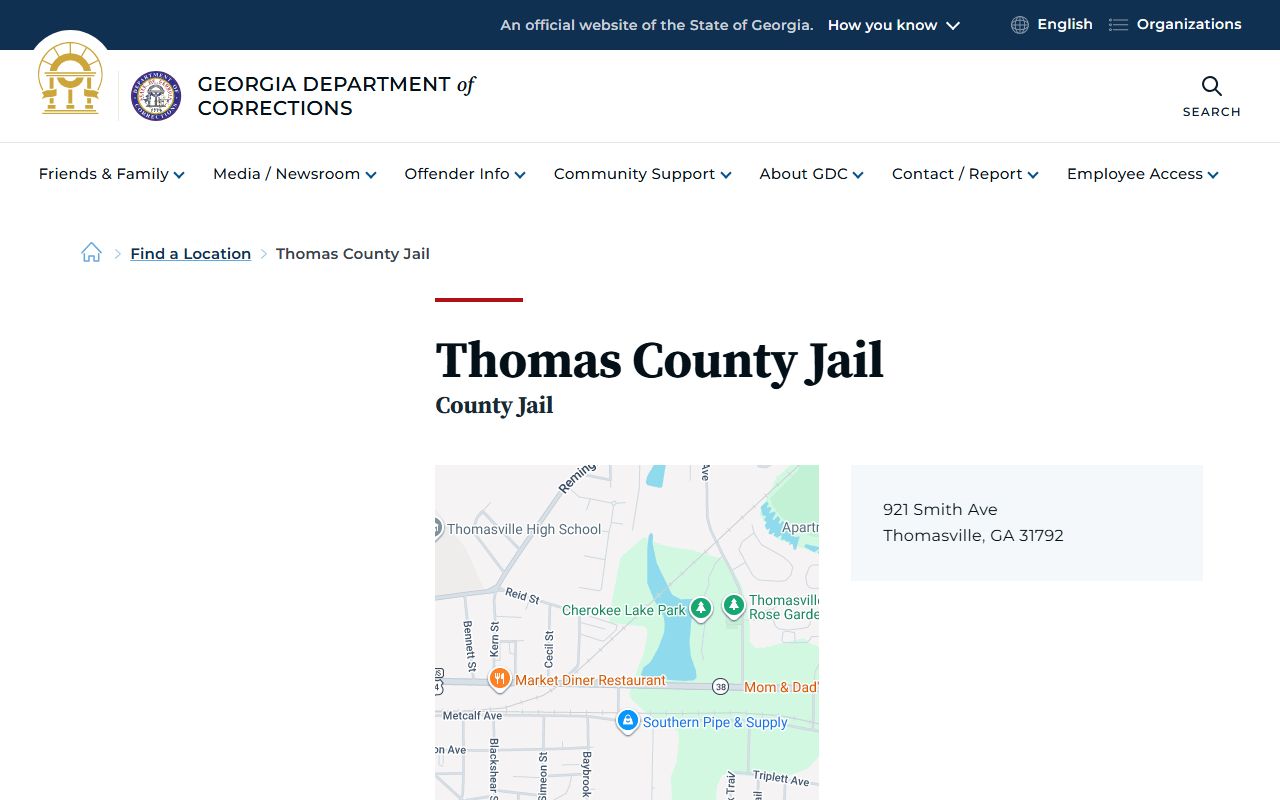
That listing confirms the jail location context, while charge status still belongs with the court and prosecutor records.
The Georgia.gov offender search source explains the statewide offender-search path.
Use statewide offender search for sentenced offender location, not as a substitute for Thomas County court charge disposition.
The Georgia VINE source is assigned to custody and case notifications.

VINE can help with custody-status notice, but it is not the filed criminal case record kept by the Clerk.
Restricted Arrest Records in Thomas County
Georgia criminal-history restriction rules may apply to some arrests and charges. The first step is to identify whether the issue is an arrest record, jail booking, court case, conviction, or agency report. For arrests after July 1, 2013, the GBI source says there is no separate application process and the prosecutor must be contacted. For older arrests, the arresting agency may be part of the process. Court records may require a court order for sealing or restriction.
Juvenile law-enforcement files and juvenile court records are restricted differently from adult arrest records. Adoption, mental-health, and certain personal identifying information may also be sealed, redacted, or withheld. A person seeking correction or restriction should get the court disposition, identify the prosecutor and arresting agency, and ask the proper office what local process applies.
Note: Restriction eligibility depends on the charge, date, disposition, agency record, and any court order.