
What Probate Covers in Thomas County
Thomas County Probate Court is a separate local court at 325 North Madison Street, Thomasville, GA 31792. The office is open Monday-Friday, 8 a.m.-5 p.m.; phone is 229-225-4116 and email is probatecourt@thomascountyga.gov. The county names Judge Josh Smith on the Sheriff's courthouse page. Probate Court's primary function is to ensure estates and guardianships are administered according to law, and the Probate Judge decides estate and guardianship controversies in non-jury trials.
Official jurisdiction includes probate of wills, appointment and removal of executors and administrators, sale and disposition of estate property, appointment and removal of guardians and conservators for minors and incapacitated adults, audit of fiduciary returns, mental-health and substance-abuse commitments, marriage licenses, weapons carry licenses, elected-official oath and bond recording, and certificates of residence.
Probate Terms Defined
Probate filings use terms that identify the person who died, the person asking the court for authority, and the duty being supervised. These definitions help match a file to the correct portal module or Probate Court request.
- Testator
- A person who made a will.
- Executor
- A person named in a will to carry out estate administration after the court approves the appointment.
- Administrator
- A person appointed to administer an estate when there is no executor available or no valid will controls.
- Intestate
- Dying without a valid will, which means distribution follows Georgia law rather than a will.
- Guardian
- A person appointed to make personal-care decisions for a minor or incapacitated adult.
- Conservator
- A person appointed to manage property or finances for a protected person.
- Fiduciary return
- An accounting or report filed by a person managing estate or protected-person property.
How to Search Thomas County Probate Court
The online starting point is Georgia Probate Records, which lists modules for estates, marriages, wills, guardianships, death records, calendars, miscellaneous filings, weapons carry applications, and fee calculation. Dynamic module fields were not fully exposed in the static capture, so users should expect the portal to ask for case-specific names, dates, or filing categories after selecting a module.
The manifest image below comes from Georgia Probate Records, the statewide probate portal used for Thomas County modules.
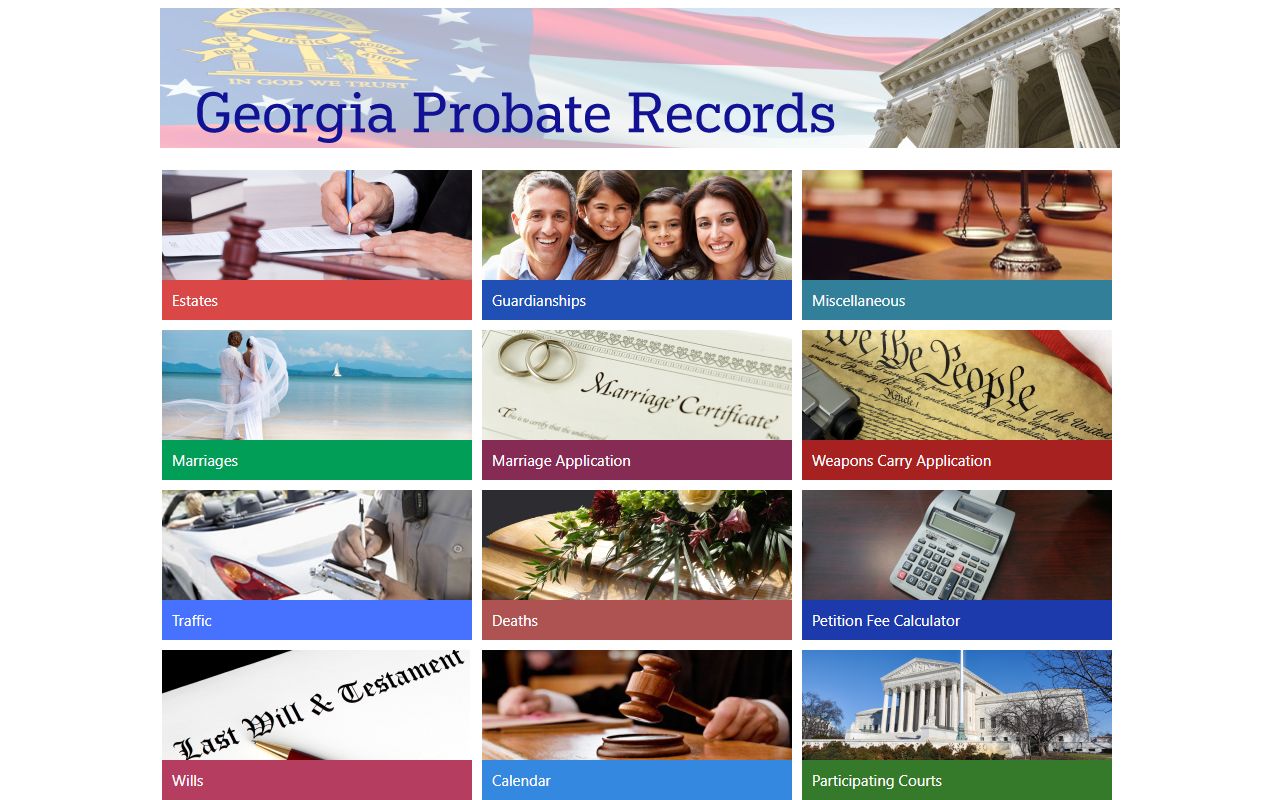
The portal is useful for initial lookup and applications, but Probate Court should be contacted when the record is restricted, recently filed, not indexed online, or needed as a certified copy.
- Identify whether the matter is an estate, will, guardianship, conservatorship, marriage, weapons carry, or commitment-related filing.
- Search the matching Georgia Probate Records module when available.
- Contact Thomas County Probate Court if the portal does not locate the matter or if the file may be confidential.
- Use Probate Court forms and the fee calculator before filing a new petition.
- Request certified copies, letters, or court-certified documents directly from Probate Court.
Probate Courts in Thomas County
Thomas County has one county Probate Court for the researched probate functions. Probate Court is at the same North Madison Street courthouse used for several other court offices, but it is separate from the Clerk's Superior and State Court records. Marriage licenses and probate estates go to Probate Court; divorces and felony civil/criminal files go through Superior Court and the Clerk.
Thomas County Probate Court
325 North Madison Street
Thomasville, GA 31792
229-225-4116
Monday-Friday 8 a.m.-5 p.m.
Probate Filing Fees
Thomas County links probate users to Georgia Probate Records court fees and a petition fee calculator, but the exact probate petition fee table was dynamic and not fully captured in the static research. For estate, guardianship, will, or weapons carry filings, use the calculator and confirm the final amount with Probate Court before filing.
| Item | Amount / Source |
|---|---|
| Estate petition filing | Use Georgia Probate Records fee calculator; exact static fee not captured |
| Letters testamentary or administration | Confirm with Probate Court; exact static fee not captured |
| Guardianship or conservatorship petition | Use Georgia Probate Records fee calculator; exact static fee not captured |
| Certified probate copy | Request quote from Probate Court based on document and certification needed |
| Marriage license | $16 with premarital counseling or $56 without premarital counseling |
What Thomas County Probate Court Records Show
Probate estate files may include petitions, wills, death information, heirs or beneficiaries, executor or administrator appointments, notices, inventories, fiduciary returns, accountings, sale or disposition orders, and final discharge documents. Guardianship and conservatorship files may include petitions, medical or capacity-related information, appointment orders, annual reports, inventories, and accounting material. Weapons carry, marriage, and miscellaneous filings have different fields and access rules.
The manifest image below comes from Georgia.gov's marriage-license overview, which explains the statewide county-probate-court role in marriage licensing.
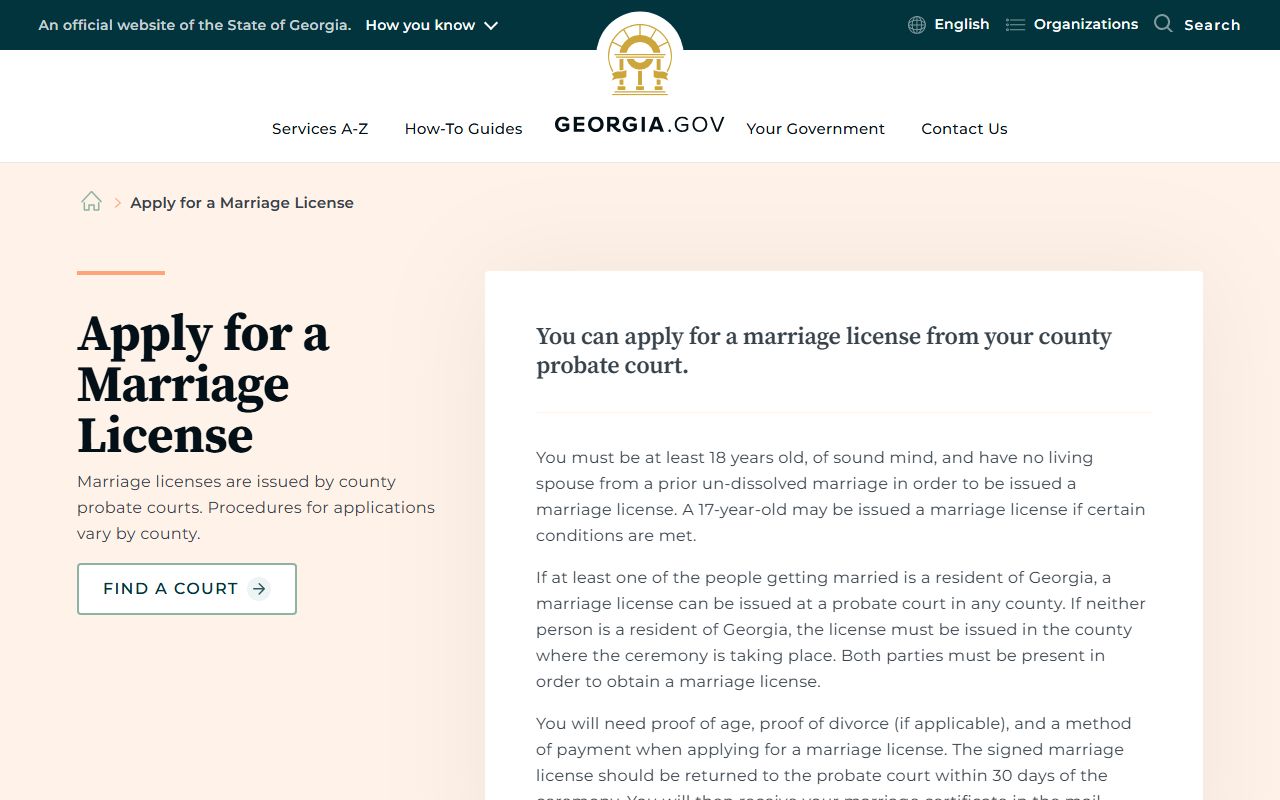
Marriage licensing is one part of Probate Court jurisdiction, so marriage records should not be confused with estate or guardianship probate files.
Probate Forms and Filing Steps
Thomas County links to Uniform Probate Court Rules and Georgia Uniform Probate Court Forms. A new estate or guardianship filing should begin by selecting the correct form, checking the fee calculator, and calling Probate Court if the filer is unsure about procedural requirements. Court staff can answer questions about services and procedures, but state law prohibits staff from rendering legal advice, restating the law, or recommending a specific legal action.
- Choose the correct matter type and form category.
- Gather required death, will, heir, fiduciary, or guardianship information.
- Calculate or confirm filing fees before submission.
- File the petition and follow notice, citation, and hearing instructions from the court.
- File required inventories, returns, accountings, or reports after appointment.
Restricted Probate Court Records
Not every probate-related file is public in the same way. Mental-health and substance-abuse commitment records are sensitive and should be treated as restricted. Guardianship and conservatorship records can contain medical, financial, or minor information. Sealed estate disputes, confidential personal identifiers, and protected capacity information may be withheld or redacted. When a portal search fails, contact Probate Court rather than assuming no record exists.
How an Estate File Moves Locally
A typical Thomas County estate file begins when a petitioner identifies whether there is a will and which form of administration is needed. If there is a will, the petitioner may ask the court to probate it and appoint the named executor. If there is no will, the petitioner may seek appointment of an administrator. Probate Court then reviews the petition, required notices, heir or beneficiary information, and any objections or consents required by Georgia probate procedure.
After appointment, the fiduciary may need to file inventories, returns, accountings, sale petitions, or other reports depending on the order and the type of administration. The research specifically notes Probate Court's authority to audit returns of executors, administrators, and conservators. Those later filings can be as important as the original will because they show how property was managed, whether a sale or distribution was authorized, and whether the court discharged the fiduciary.
For record lookup, names matter. Search by the decedent, petitioner, executor, administrator, guardian, conservator, or protected person where the portal allows. If the matter involves a minor, incapacitated adult, or mental-health commitment, public portal access may be limited even though Probate Court has a file.
Probate Court vs Clerk Records
Probate Court records and Clerk records overlap only in limited ways. The Clerk of Superior, State, and Juvenile Courts is the custodian for Superior Court divorce, felony, civil, juvenile, land, lien, and judgment records. Probate Court is the custodian for probate estates, wills, guardianships, conservatorships, marriage licenses, weapons carry applications, and miscellaneous probate services. A will contest, probate appeal, or related civil action can create records in more than one office.
The courthouse location can make this confusing because Probate Court and the Clerk are both tied to the North Madison Street courthouse. The practical rule is to follow the case type: estates and marriage licenses to Probate Court, divorces and felony or civil Superior Court cases to the Clerk, traffic and misdemeanors to State Court and the Clerk, and small claims or warrants to Magistrate Court at 921 Smith Avenue.
Probate Court also handles weapons carry license applications and miscellaneous oath, bond, and certificate-of-residence services. Those filings are probate-office records even though they are not estate files. A person searching for a weapons carry application, marriage license, or guardianship petition should not start with the Superior Court criminal or civil portal unless the matter later produced a separate appeal or related lawsuit.
For courthouse visits, bring the case name, filing year, document type, and any portal result printed or saved from Georgia Probate Records. Call ahead when a hearing, certified letters, or restricted file access is involved.